
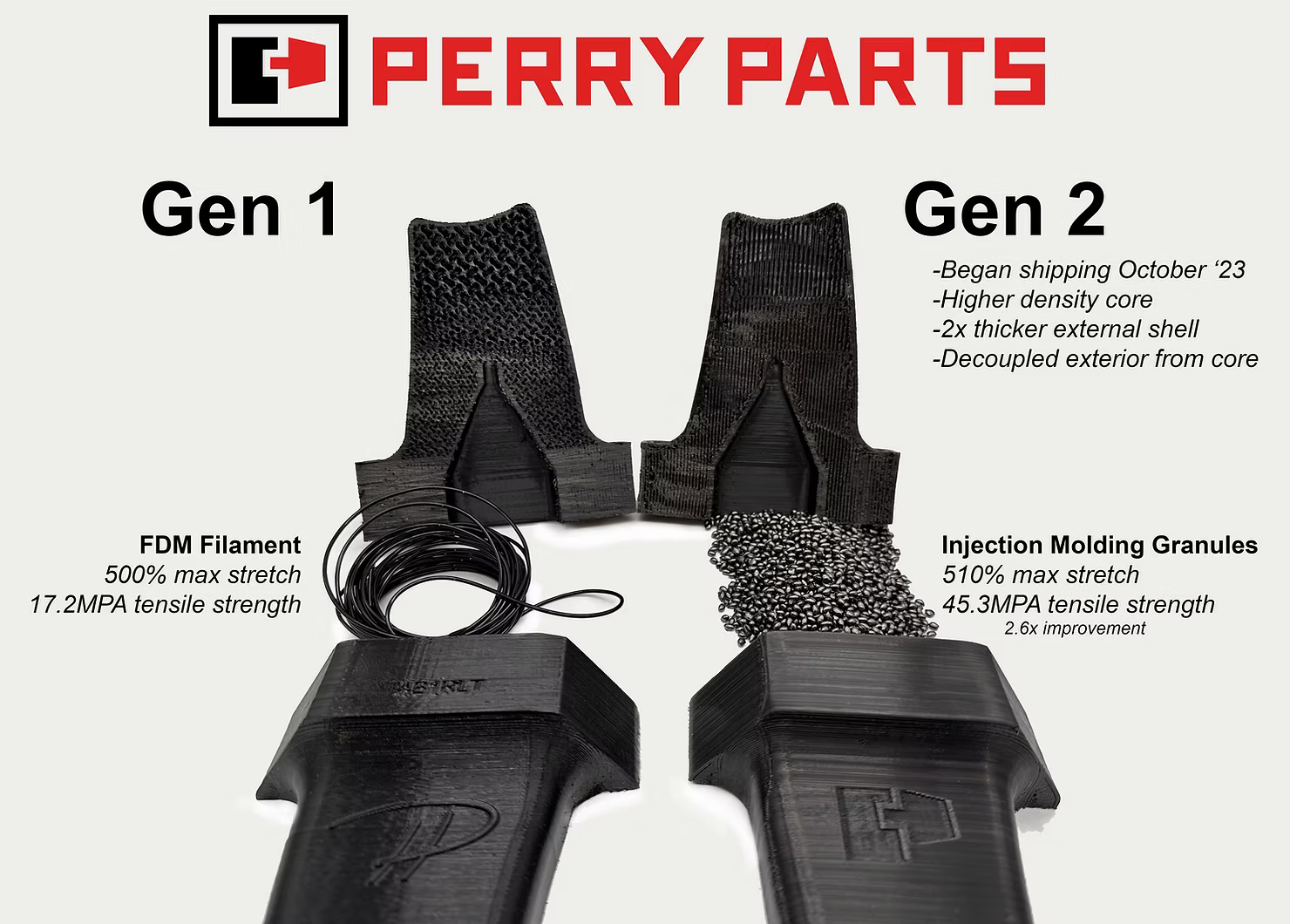
When we started this business, it was truly an adventure into the unknown. While I have an engineering background in 3D printing, applying 3D-printed parts in such high-stress and high-strain applications was an entirely new challenge.

Cross section comparison between Gen1 and Gen2
Now, a little over a year into running this business, I am excited to share some news. By partnering with Covestro, a U.S.-based polymer supplier, we’ve selected an entirely new material to build our product. This material is over two times stronger than what we previously used. Our transition was made possible because we developed and built custom 3D printers in-house that can directly print using injection molding materials.

Specialty print heads designed for our new material
This shift means that we will no longer rely on traditional 3D printing filament for all of our products moving forward, which will significantly enhance the durability and longevity of our products in the field. Partnering with a true industrial material supplier, rather than filament suppliers, also improves the consistency and quality of our materials—and, by extension, our finished products. We can now purchase material by the ton rather than by the kilogram.

Hauling our first shipment of material to the shop.
Additionally, we have invested in a suspension dyno to conduct longevity testing in-house. This equipment will allow us to assess how well our products hold up over time and to benchmark them in a dynamic way—which is the ideal method for testing suspension components.
Share:
Gen 2 Upgrade Program